Artificial Intelligence & Arterial Disease |
| Evolving Role of Artificial Intelligence in Healthcare |
Describe the evolving role of artificial intelligence in healthcare and its emerging applications in vascular imaging and diagnostics. |
| Never Lose the Vein… Turn-by-Turn DVT Scanning |
Describe the application of artificial intelligence technology in ultrasound imaging and its role in supporting vascular assessment and patient care. |
| Complex Aortic Aneurysms: Endovascular Treatment & Decision-Making |
Analyze complex aortic aneurysm pathology and evaluate contemporary endovascular treatment strategies, with emphasis on imaging assessment, procedural planning, and clinical decision-making. |
| Carotid Disease: Evidence, Controversies & Decision-Making |
Evaluate current evidence and controversies in the diagnosis and management of carotid artery disease to support informed clinical decision-making. |
Transcranial Doppler (TCD) |
| Which Way Does It Go? Collateral Pathways & TCD Interpretation |
Evaluate cerebral collateral flow pathways and analyze their impact on transcranial Doppler (TCD) examination interpretation and diagnostic accuracy. |
| TCD: Detour Ahead |
Explain the role of transcranial Doppler ultrasound in identifying vascular obstruction and collateral cerebral blood flow patterns. |
Peripheral Arterial Disease |
Deep Venous Arterialization: Saving Lives and Limbs in 2026 |
Describe the indications, procedural principles, and imaging considerations of deep venous arterialization for limb salvage in patients with no-option chronic limb-threatening ischemia. |
| Connecting the Foot: Pedal Arch & Pedal Loop |
Explain the role of duplex ultrasound in the evaluation of pedal loop anatomy, arterial flow, and collateral circulation in the lower extremity. |
| From Heel to Flow: Pedal Loop |
Describe the duplex ultrasound findings and clinical significance of pedal loop anatomy and lower extremity arterial flow in a vascular case study. |
| What’s the Diagnosis? Vascular Imaging Challenge |
Apply vascular imaging knowledge and diagnostic reasoning skills to identify and interpret findings presented in interactive case-based challenges. |
Venous Disease & Deep Vein Thrombosis |
| Venous Ultrasound in the Deep Veins - From Findings to Intervention |
Analyze duplex ultrasound findings and diagnostic considerations associated with deep venous thrombosis involving the peripheral and central venous systems. |
| Collateral Escape: Central Vein Crossroads |
Analyze imaging findings in central venous compression (Nutcracker and May-Thurner) with ovarian vein reflux and collateral pathways. |
| Decoding Pelvic Congestion |
Evaluate duplex ultrasound hemodynamics of chronic venous insufficiency and pelvic venous congestion, including reflux patterns, valve incompetence, and venous segment involvement, and correlate imaging findings with disease severity and clinical presentation in ovarian vein reflux, Nutcracker, and May-Thurner syndromes. |
| Following the Flow: A Venous Reflux Case Study |
Evaluate lower extremity venous reflux examination findings using duplex ultrasound, including identification of reflux patterns and venous incompetence, and correlate imaging results with clinical presentation and disease severity. |
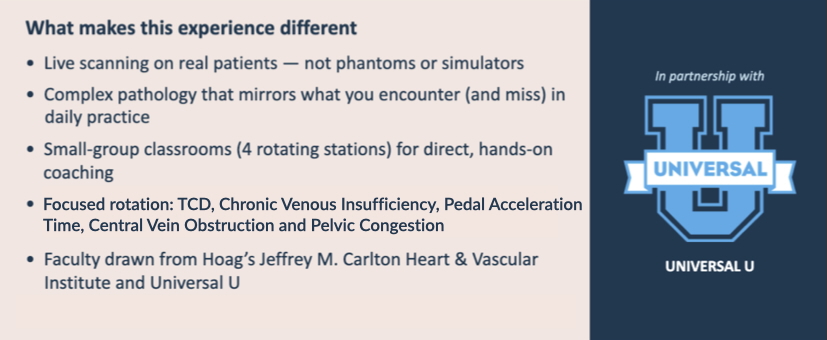
Hands-On Training - In Collaboration with Universal U |
| Hands-On Sessions TCD • Venous Reflux • Pedal • Central Vein Obstruction / Nutcracker / Ovarian
|
Demonstrate hands-on proficiency in vascular ultrasound techniques through live patient scanning - including TCD evaluation of detours and flow reversal, lower extremity venous reflux assessment, pedal loop scanning, central vein imaging, and pelvic venous imaging of deep vein thrombosis, nutcracker and ovarian vein systems - and correlate real-time findings with clinical interpretation and diagnostic significance. |